HIFU vs RF: Which Lifting Treatment Is Right for Your Skin?
2026.06.22
Ever look in the mirror and think, "Hmm, my jawline isn't what it used to be"?
When your cheeks start to sag a bit, your face looks heavier, and your profile isn't as defined, you might consider, "Maybe I should try a lifting treatment." But as soon as you start searching, it can feel overwhelming.
Ultherapy, Thermage, Shurink, InMode, Onda... So many names, but what do they all really mean?
I hear this question often during consultations:
"Doctor, what's the difference between this one and that one?"
To be honest, lifting devices are best understood by their principles, not their brand names. Specifically, they fall into two categories: ultrasound (HIFU) and radiofrequency (RF).
Once you understand what type of energy they use, you can better determine which is right for your sagging concerns.
Since lifting is an area we focus on at our clinic, today I'll break it down in the simplest way possible.
Lifting Devices Essentially Fall Into Two Categories
Even though there are dozens of lifting devices, they can be broadly classified based on how they deliver heat into the skin.
These are ultrasound (HIFU) and radiofrequency (RF). Understanding these two categories is half the battle.
- HIFU (Ultrasound) - Focuses energy to a precise point deep in the skin. The aim is to stimulate the deep structural layer (SMAS) to lift sagging tissues.
- RF (Radiofrequency) - Distributes energy broadly to heat the dermis and subcutaneous layers evenly. It's focused on enhancing overall skin elasticity and tightening.
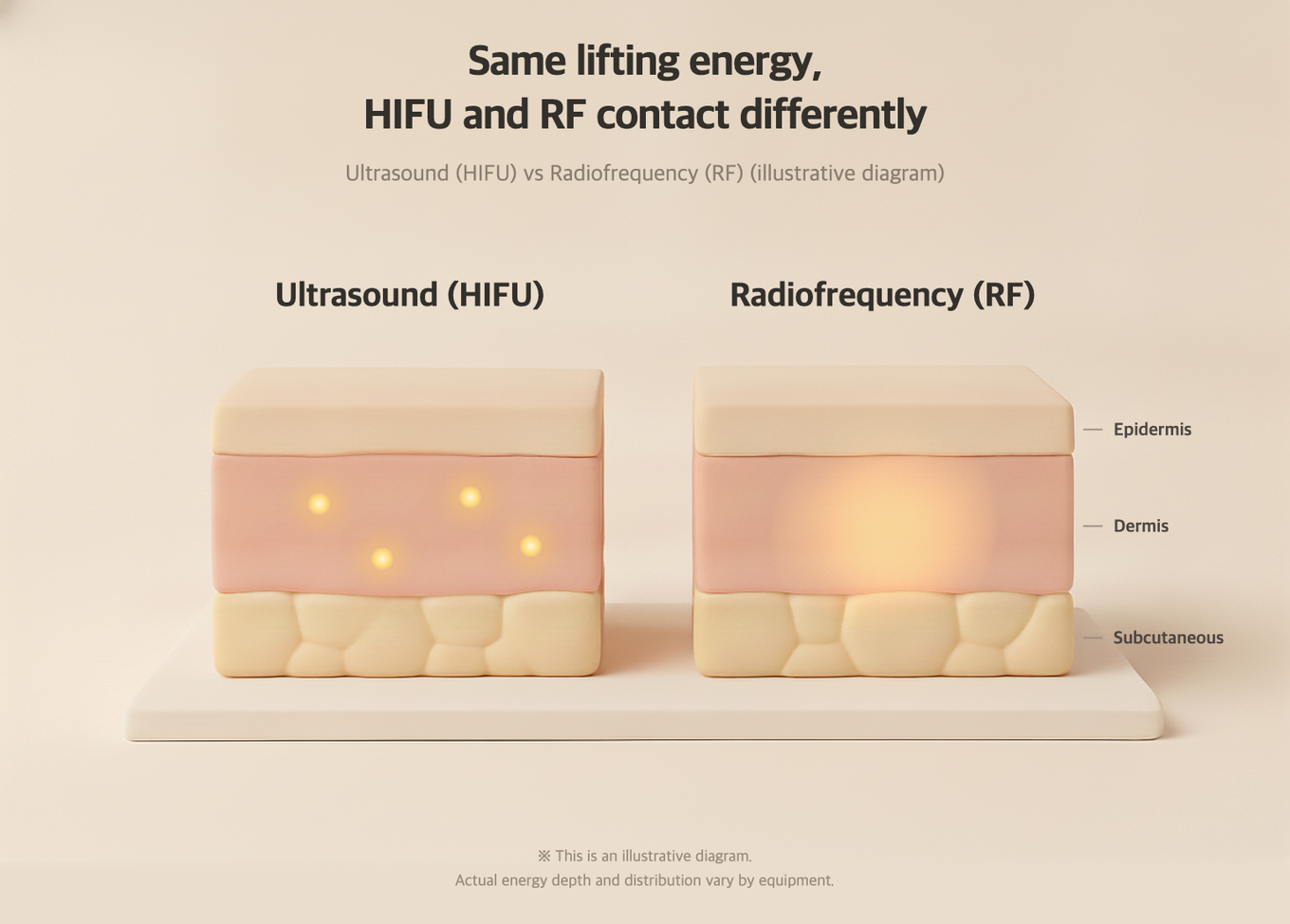
💡 Think of it this way - HIFU is like a pinpoint, while RF is like a gentle warming blanket. Both promote collagen renewal, but they target different depths and use different approaches.
HIFU Devices - Ultherapy Prime / Shurink Universe / Titanium
If you're looking to lift the 'structure', HIFU devices are the way to go.
These devices concentrate ultrasound energy at a point to cause immediate collagen contraction and stimulate regeneration over several months.
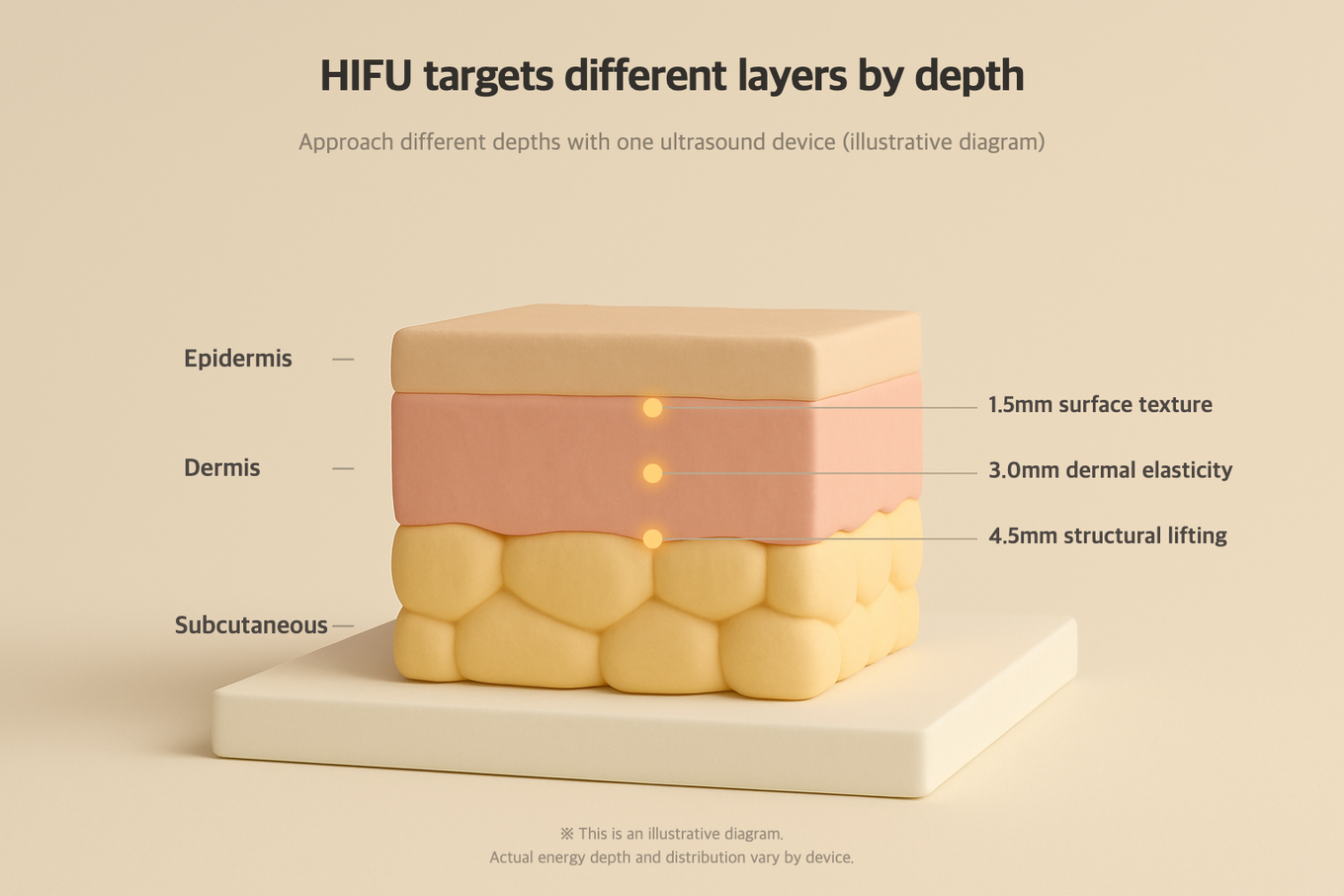
The key to HIFU is its ability to target specific depths.
Typically, it targets 1.5mm / 3.0mm / 4.5mm, with the deepest being the SMAS layer, the same layer that is tightened during a surgical facelift.
HIFU's unique feature is its non-surgical stimulation of this deep layer.
At our clinic in Myeongdong, Seoul, we offer these HIFU devices:
- Ultherapy Prime - A leading HIFU option. Its precise targeting by depth makes it ideal for areas like the jawline and double chin, where structural heaviness is an issue.
- Shurink Universe - Uses the same ultrasound principle, suitable for treating larger areas.
- Titanium - Another HIFU device (Ultraformer MPT) that approaches lifting by targeting multiple layers.
⚠️ Keep in Mind - Since HIFU targets deep layers, you may feel a bit of a heavy sensation during the procedure. Sensations vary greatly from person to person, so it's best to get pre-treatment advice.
🩺 Doctor's Note - In practice, for issues like a heavy jawline or double chin, I often start with a HIFU device. However, using a strong HIFU on thin skin or low-fat areas can make the face look sunken, so remember, stronger isn't always better.
RF Devices - Thermage FLX / InMode / Onda Lifting
If your skin feels generally less firm and you're worried about fine lines or pores, RF devices might be more suitable.
RF energy heats the dermis and subcutaneous layers broadly, promoting collagen contraction and renewal for tightening-focused results.
The advantage of RF is its ability to treat large areas evenly with minimal downtime.
At our Myeongdong clinic, we offer these RF devices:
- Thermage FLX - Uses monopolar RF to heat the dermis and subcutaneous layers volumetrically. It's often recommended for elasticity loss, fine lines, and pores.
- InMode - RF-based, used to create a tightening sensation in specific areas.
- Onda Lifting - Technically a microwave device, but similar to RF in that it heats large areas for elasticity and contouring.
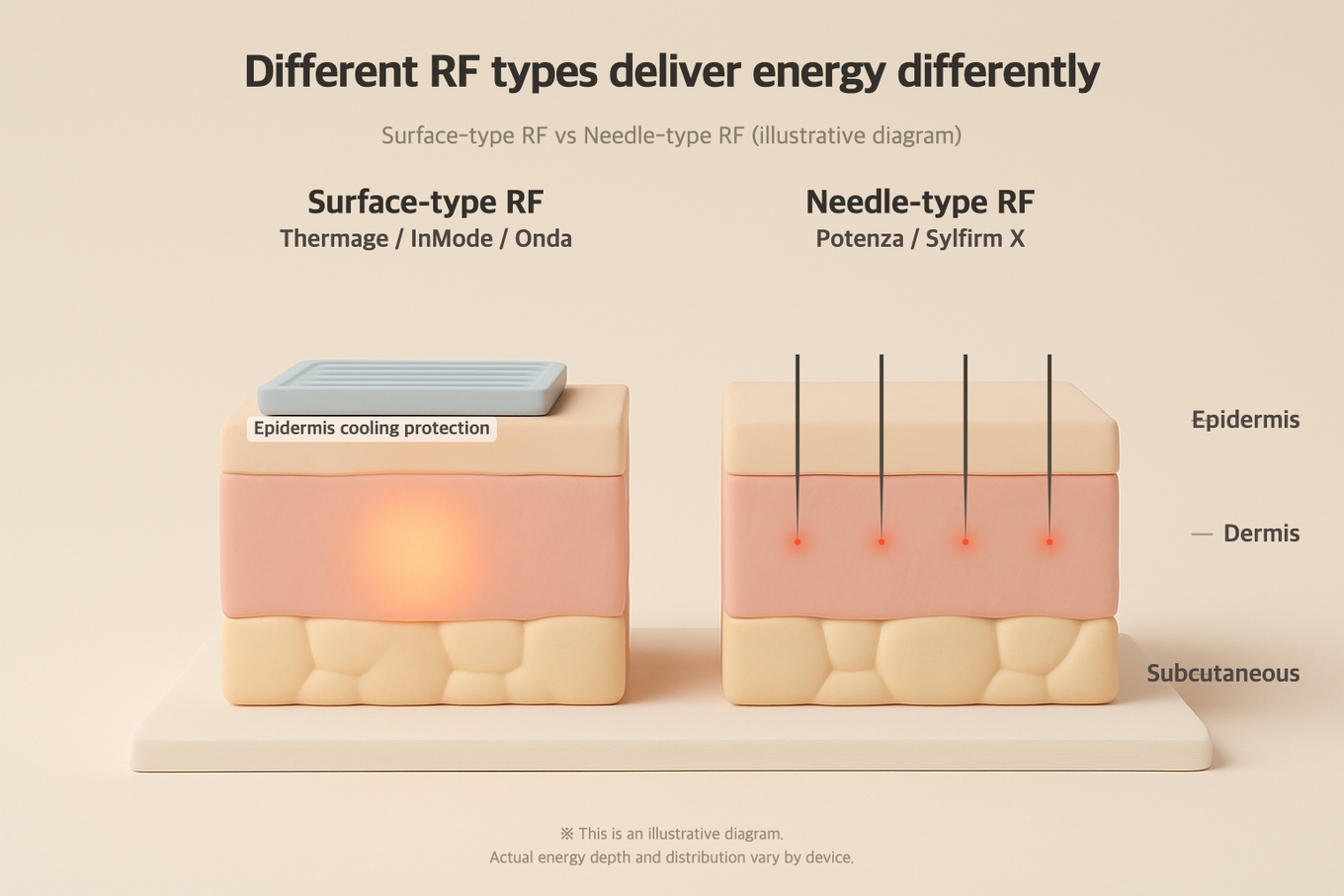
We also have RF microneedling devices like Potenza and Sylfirm X.
These use fine needles to deliver RF energy into the skin, addressing pores, scars, and elasticity differently. Surface-heating RFs like Thermage and needle-based RFs serve distinct purposes.
🩺 Doctor's Note - If fine lines are your main concern and your skin is thin, RF devices might be a better fit. The approach varies based on whether the issue is structural or elasticity-related.
So, What's Right for My Sagging?
The key is to first identify 'what's causing the sagging'.
Not all sagging is the same. The table below can be a starting point for your decision.
| Concern Type | Primary Cause | Suitable Category | Example Treatments |
|---|---|---|---|
| Heavy Jawline/Double Chin | Structural sagging in deep layers | HIFU (Ultrasound) | Ultherapy Prime / Shurink Universe |
| Overall Skin Laxity | Dermal elasticity loss | RF (Radiofrequency) | Thermage FLX / InMode |
| Fine Lines/Pores | Surface elasticity + texture | RF Tightening | Thermage FLX / Onda Lifting |
| Pores/Scars + Elasticity | Dermal remodeling | RF Microneedling | Potenza / Sylfirm X |
A common misconception I encounter:
"Which is better, HIFU or RF?"
There's no 'better' - they're just different tools for different targets.
If structural sagging is your issue, RF alone might not suffice, and if elasticity is the concern, only using HIFU might leave some areas untreated. Often, a combination approach is used.
Effectiveness and duration vary for each individual. Factors like skin thickness, sagging extent, age, and lifestyle affect results, so base your choice on your skin's condition rather than brand names or reviews.
🩺 Doctor's Note - At our clinic, we prioritize 'what suits my skin' over 'which device is better'. We consider sagging degree, skin thickness, and fat content to determine the appropriate category, sometimes combining treatments if needed.
Frequently Asked Questions
Q. Can I get Ultherapy and Thermage together?
They can be considered together, as they have different principles. Ultherapy (HIFU) targets deep structures, while Thermage (RF) focuses on surface elasticity, making them complementary for sagging and elasticity loss.
However, whether to have them done simultaneously or at separate times depends on skin condition, so consult before treatment.
Q. Will I see immediate results after one session?
Both HIFU and RF stimulate collagen regeneration, so changes occur gradually over weeks to months rather than immediately after treatment.
Immediate post-treatment sensations can differ from the appearance a few months later, with variation among individuals.
Q. I'm worried about pain or downtime.
Generally, HIFU, which targets deeper layers, can feel more intense during treatment, while RF, which heats the surface, is known for minimal downtime.
However, pain perception varies greatly, and it also depends on the treatment area and intensity.
Q. I'm not sure which treatment to choose.
Start by discerning whether your issue is sagging or elasticity loss, or both. The table above can help narrow down your concerns.
Accurate assessment is best made after a direct skin examination.
Q. At what age should I start lifting treatments?
There's no set age. In your 20s and 30s, lighter treatments for prevention and maintaining elasticity are common, while addressing structural issues becomes more relevant as sagging progresses. Your current skin condition, not age, should be the deciding factor.
Q. Can I resume daily activities immediately after treatment?
RF treatments typically have minimal downtime, allowing for same-day recovery, while HIFU may cause temporary redness or slight swelling, which usually subsides quickly. However, it can vary by treatment area and intensity.
In Summary
Lifting treatments might seem complex and expensive, but understanding 'where your sagging originates' simplifies your options.
Don't get swayed by names; start by distinguishing between ultrasound and radiofrequency.
This alone clears up half the confusion.
#Lifting #Ultherapy #Thermage #HIFU #RadiofrequencyLifting #SeoulDermatology #JawlineLifting #ElasticityLifting
Back to list