Why regenerative treatments are gaining attention: the shift toward recovery-focused aesthetics
2026.09.16

Why “regeneration” is gaining attention: from intensive procedures to recovery-focused aesthetics
“Doctor, a few years ago I would have just booked a strong lifting treatment. Now everyone talks about regeneration. Is it just a trend?”
I hear this question much more often in consultations now, and I welcome it. It captures a broader shift that has quietly taken place across the aesthetics market in recent years.
Put simply, the focus is moving from intensive procedures that create a dramatic change in one session toward regenerative approaches that help skin recover for itself. The attention around stem cells, exosomes and skin boosters is part of that larger movement.
This article does not recommend a particular procedure. Instead, we will explore why regeneration has come to the fore now. Understanding the context helps you make your own judgment rather than follow a trend. A separate article on the principles of stem-cell treatments explains the differences between injections, conditioned media and exosomes in greater depth.
At a glance
- The emphasis in aesthetics is shifting from dramatic alteration toward supporting recovery.
- Three factors are driving this: filler fatigue, a changing definition of “natural,” and a greater value placed on sustainable care.
- Regenerative approaches, including stem cells, exosomes and skin boosters, fit this shift because they aim to prompt the skin’s own response rather than simply add volume.
- The word “regenerative” does not make every treatment impressive. Popular trends call for a critical eye toward exaggerated claims.
- The question is whether the approach fits your skin goals, rather than whether everyone else is doing it. Why is everyone talking about regeneration?
Why is everyone talking about regeneration?
This is less a passing fashion than a shift in how people approach aesthetics.
A few years ago, treatment choices often centered on how definite and dramatic the change would be: strong lifting, plump volume and visible transformation. A more pronounced result was often seen as a better result.
Recently, that emphasis has changed. The question is shifting:
From “How much will I change?” to “How subtly, sustainably and healthily can I maintain the result?”
International beauty publications discussing 2026 describe a similar shift away from a focus on fillers and Botox for quick correction toward skin quality and long-term health. Market reports covering regenerative approaches also describe steady growth in recent years. Figures differ between reports, so it is more useful to read them as a signal of direction than to focus on a precise number.

From adding volume to helping skin improve itself: focusing on healthier skin rather than greater fullness.
Three factors behind the shift
Why has this change gathered pace now? From what I see in practice, three factors stand out. Let us look at each.
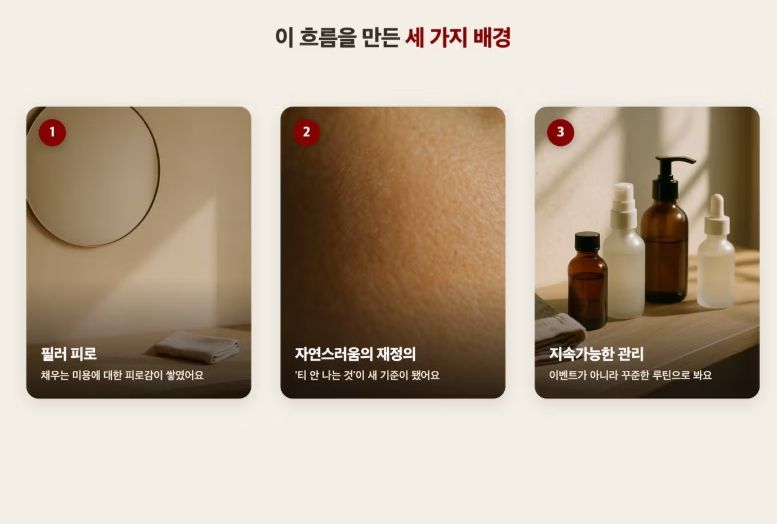
An orderly dressing table, healthy skin that looks naturally bare, and daily skincare: three images behind the regenerative trend.
The first is commonly called “filler fatigue.” After years of popularity for filler and Botox approaches to adding volume and lifting, people have also become familiar with their unwanted results.
One example is an overfilled, unnatural-looking face, often described as overcorrection. Seeing many such examples has made people think, “I do not want to go that far.” It is a kind of weariness with volume-focused aesthetics.
💡 Where more filling and more lifting once seemed like the answer, many people now want less intervention and a more natural look. This is the first reason attention has turned toward regeneration.
Two: the definition of “natural” has changed
The second factor is a change in what “natural” means. It once meant becoming more attractive without an obvious transformation. Now the standard is that the treatment itself should not be detectable.
The goal has moved from a face everyone notices has changed toward looking like someone whose skin was always good. By that standard, gradually improving skin texture, tone and firmness is more appealing than one intensive transformation.
“I would rather just look like I have good skin than look dramatically different.”
I hear this frequently in consultations. That one sentence captures the direction of the trend.
Three: from a one-off event to ongoing care
The third factor is a shift from treating aesthetic procedures as a major one-time event toward making them part of an ongoing routine.
Treatment used to be something people saved for a special occasion. Increasingly, they see it as a habit for maintaining skin condition, like exercise or skincare. Gradual, sustained care consequently feels more natural than a dramatic one-session change.
💡 Think of an intensive procedure as a major one-time operation, and a regenerative approach as closer to a health-maintenance routine. When goals change, the treatments people seek also change.
Why regenerative approaches sit at the center of this shift
The three factors point toward the answer. Regenerative approaches fit the desire to move beyond filler fatigue, achieve natural results and maintain ongoing care.
Stem-cell approaches, exosomes and skin boosters share an emphasis on sending signals that encourage the skin’s own response, rather than simply filling space. Changes therefore tend to develop gradually and subtly, fitting a routine of continued care.
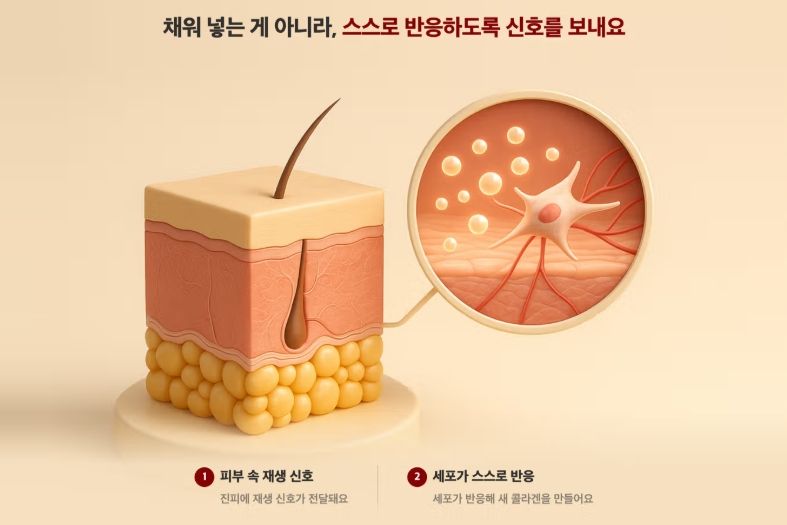
Cells respond to regenerative signals delivered to the dermis by producing collagen themselves.
- A response to filler fatigue: the emphasis is on improving skin condition rather than adding volume, so concern about overcorrection is relatively lower.
- A response to the desire for natural results: the aim is to look naturally well, rather than dramatically altered, which fits current expectations.
- A response to ongoing care: changes develop through care over time rather than a single finished event, fitting a routine-based approach.
One distinction matters here: regenerative treatments are not a single category with one mechanism. Stem cells, conditioned media and exosomes differ, as do autologous materials from your own body and allogeneic materials from others. These distinctions go beyond this article; the separate explanation of injections, conditioned media and exosomes covers them. For context, MetaCell, presented as a stem-cell approach at Forever Myeongdong, is closer to an autologous approach using components obtained from your own body, rather than another person’s cells.
The more popular a trend, the more carefully to assess its claims
At this point, regeneration may sound universally beneficial. It is worth taking a step back, because growing trends are often accompanied by exaggerated marketing.
“Regeneration” sounds appealing, so the word is being applied widely. In consultations, I encourage people to be more questioning when a term becomes fashionable. Here are a few things to watch for.
“Fundamental regeneration in a single session” is a particular red flag. Regenerative approaches are based on gradual skin responses, not necessarily a dramatic one-off change, and those responses vary considerably. The more absolute the claim, the more carefully it deserves to be examined.
Not everything called “regenerative” is the same. Different approaches use different materials, mechanisms and evidence. A shared label should not be taken to mean they are equivalent.
Safety and regulatory status also differ. Working directly with cells and using conditioned-media products can fall into different legal categories. Actual approvals and classifications should be checked against official authorities such as South Korea’s Ministry of Food and Drug Safety. Look beyond the word “regenerative” and ask what material is used, on what evidence, and within what permitted scope.
⚠️ Take particular care if the only motivation is “It is popular, so I should do it too.” A trend does not establish whether it suits your skin goals. Understand the direction first, then consider how it fits your situation.
Frequently asked questions
Is the popularity of regenerative treatment just a fad?
It appears closer to a change in the way people approach aesthetics than a short-lived fashion. The focus is moving from a large one-time transformation toward maintaining skin quality, and regenerative approaches align with that direction. However, a promising trend does not make every regenerative claim credible; exaggerated marketing still needs scrutiny.
Does that mean intensive lifting treatments are now bad?
No. The procedures have not become bad; they serve different goals. Lifting approaches suit a goal of clearer contour changes, while regeneration-focused approaches fit gradual improvements in texture, tone and firmness. The shift is about what people increasingly want, rather than which treatment is universally better.
Are exosomes, stem cells and skin boosters all the same treatment?
No. They share the regenerative label, but their materials and mechanisms differ. Introducing cells directly, using cell-conditioned media, and using purified signaling components such as exosomes are distinct approaches. The article on the principles of stem-cell treatments explains these differences in detail.
Are regenerative treatments guaranteed to work?
Results cannot be guaranteed in this field. Although there are underlying mechanisms, clinical evidence varies by category and product, and responses differ between people. These approaches generally aim for gradual change over time, so expecting a large immediate transformation can lead to disappointment. It is more accurate to consider the potential benefit of a given mechanism while allowing for individual differences.
Should I have a regenerative treatment?
The deciding factor should be whether it fits your goals, not whether it is fashionable. If you want to maintain skin condition over time, the approach may fit. If you want an immediate, clearly visible change, it may not match your expectations. What suits you depends on your skin and goals. Understand the context, then make the decision according to your own needs.